Note No. 2 - What Your Bread Lost Before You Bought It
First: thank you for being here. Whether you found us at a market, through a friend, or you've just been watching from the sidelines — you're early. That means something to us.
We're six weeks into our launch, and we're finally finding our rhythm. You'll be able to find us most often at the Denison, Van Alstyne and Melissa markets; with a few special markets here and there, like Moonlight in Sherman.
But don't sweat it if you didn't make it to market. Ordering online allows you to select delivery for a $6 fee, free pickup at our home in Sherman, or pre-orders for our upcoming markets.
We have a lot coming late this summer fall, and we want you be along for the ride. New products, new recipes, and a bake-along series that will help you put better food on your table from the local farmers and vendors we're meeting along the way. Make sure you follow us on Facebook, leave a review, and comment for special deals and perks for our top fans.
Seriously, thank you for being here. Let's make something yummy that won't upset your tummy.
What your bread lost before you bought it.
I've been baking with commercial bread flour for years. Good flour. The kind serious home bakers reach for. And I was getting good results — or at least, I thought I was.
When we started milling our own wheat, something changed. The dough felt different from the first mix. The color was deeper. The smell was different — not overwhelming, just... present. Like it was telling you something was still alive in it. Discovering that rise times halved with our flour told the whole story. If the yeast can feast that effectively, imagine the nutrients available for us in this bread.
I didn't fully understand why until I started digging into the research. Here's what I found. The moment a wheat berry is ground into flour, the oils in the germ begin to oxidize. This isn't a slow process — it starts immediately. Vitamin E degrades. Minerals become less bioavailable. The compounds that make whole wheat nutritionally meaningful begin to break down. Eventually, those oils become rancid. So commercial flour companies began stripping them to make flour shelf stable. Unfortunately for us, that's also where all the nutrients in bread comes from.
Researchers at UCSF tracked this across every stage of processing — from raw kernel to flour to finished bread. What they found was stark: mineral levels were reduced by nearly three-quarters in refined flour compared to whole wheat. Vitamin E dropped substantially at every step, regardless of flour type. By the time bread made from commecial flour reached the table, it contained less than one-fifth the Vitamin E of the original wheat kernel.
When we combine the Killilea study from UCSF with published USDA baseline data on the nutritional content of wheat berries, what my family and I experienced switching to fresh-milled, whole wheat makes total sense. Here's the numbers laid out for you:
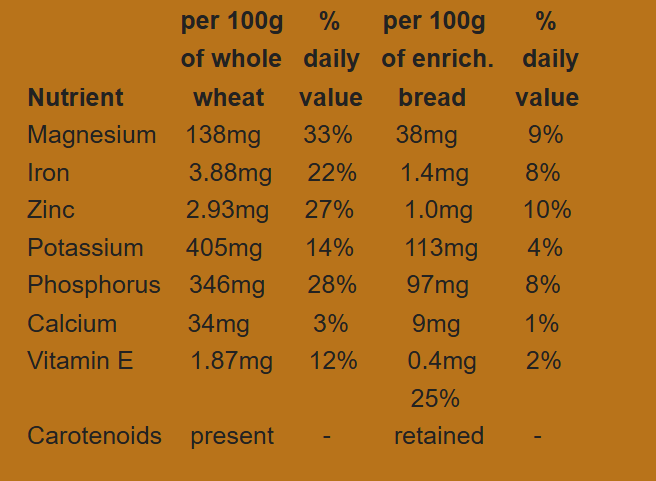
Sources: USDA FoodData Central (whole wheat kernel baseline). Retention figures derived from Killilea et al. NUTRITION 2024, American Society for Nutrition. Major minerals reduced up to 72%...
That's a sourcing problem. Fresh-milled, whole wheat will always outperform commercial flour nutritionally. These studies explain the whole vs. commercial well, but it's only part of the improvement our family began seeing when we switched. Next week, we'll talk about the timing problem that makes fresh-milled whole wheat an entirely different food group.
We're building Cross Timbers on this premise. We take nothing out of your grains, so we don't have to add anything back in to make it whole again. Bread used to be a superfood. And it can be again.
Join us for the journey, and let's do better for our families together.
This is the first deep dive of many.
Over the next several weeks, I'm going to walk through each piece of this:
Part 1 (this one): Whole wheat vs. commercial enriched bread products.
Part 2: The timing problem, and why nutrition has a shelf life.
Part 3: Enriched flour - what they put back, and whether it matters.
After that, we're going to dive into why we source the wheat that we do, and the role the chemicals in commercial agriculture play in our food stream.
If you have questions along the way, reply to this email. I read every one. See you soon, and don't be a stranger.
— Shawn